My Lyme + Co-Infection Treatment Journey
A concise, visual resource about my experience researching and discussing Lyme disease, Bartonella, dapsone-based protocols, and integrative antibiotic schedules with qualified clinicians.
Read this before anything else.
This project is built around personal experience and published references. It is not a protocol for anyone to follow without medical supervision.
Not medical advice
Use this site as a conversation starter with your clinician, not as a treatment plan.
Consult an LLMD
Complex Lyme and co-infections require individualized evaluation, monitoring, labs, and safety planning.
No cure guaranteed
Some patients report improvement or remission, but outcomes vary and risks must be monitored.
The treatment concepts this site organizes.
This site is centered on treatment concepts that I personally explored and discussed with my own Lyme-literate medical doctor (LLMD), including dapsone-based approaches described by Dr. Richard Horowitz and Bartonella-focused strategies associated with Dr. Robert Mozayeni’s clinical work.
I did not consult directly with Dr. Horowitz or Dr. Mozayeni, and they were not involved in my care. My treatment was independently guided by my own clinician, using publicly available research and clinical insights as reference points.
This website is intended to share knowledge and personal experience only, and does not represent or imply endorsement, recommendation, or responsibility by any of the physicians mentioned.
Dapsone-based Lyme protocols
This section introduces double-dose dapsone, high-dose double-dose dapsone, and pulsed approaches as topics to review with a clinician. It should not be interpreted as dosing guidance.
Bartonella-focused component
Bartonella may complicate recovery for some patients. This site highlights the importance of investigating co-infections and links to physician-authored discussions for deeper review.
Combination / sequencing concepts
The resource will organize concepts around rifampin/rifabutin, azithromycin, nitrofurantoin, methylene blue, pyrazinamide, and metronidazole as discussion points for qualified clinical care.
Metronidazole maintenance reference
A 2024 case report described one patient with recurrent relapses and remission associated with 500 mg once-weekly metronidazole. This is a single case report, not a universal recommendation.
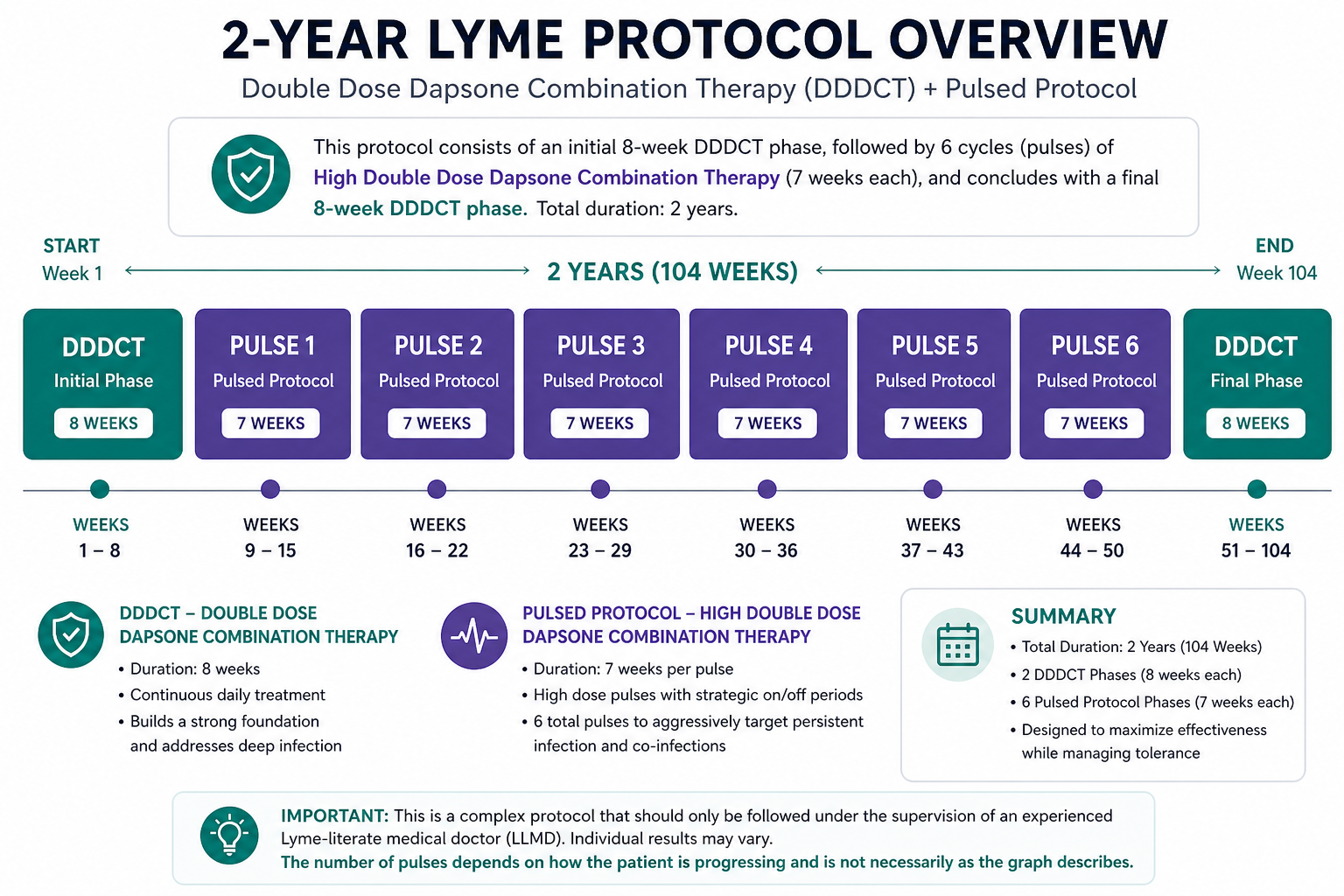
2-year protocol visual guide.
This visual summarizes the high-level two-year structure: an initial DDDCT phase, six pulsed phases, and a final DDDCT phase. Exact timing and number of pulses should be reviewed with an LLMD.
Important links for deeper reading.
Short explanations are kept concise so visitors can quickly understand the idea and continue reading from the original sources.
Antibiotic schedule template
A clean two-year spreadsheet template to organize questions, clinician notes, monitoring checkpoints, and weekly schedule planning. It is intentionally blank and should be completed with an LLMD.